Network design & implementation
LAN/WAN topology, switching, routing, racks, servers, and network policy for offices and facilities.

IT Services
LAN/WAN, Wi-Fi, fiber, racks, segmentation, and documentation for secure, scalable connectivity.
Discuss your projectAbout the solution
Networks connect users, servers, CCTV, phones, and applications. Surveys, topology, capacity, security, and testing keep every system performing consistently.
Problems the system must solve
Equipment and solution scope
The final configuration follows site conditions, integration needs, and actual usage patterns.
LAN/WAN topology, switching, routing, racks, servers, and network policy for offices and facilities.
Access-point survey and deployment for coverage, user capacity, roaming, and centralized management.
Performance audits, bottleneck remediation, configuration updates, and support to keep services stable.

What we engineer into the system
Topology is derived from users, devices, applications, coverage, growth, and availability targets.
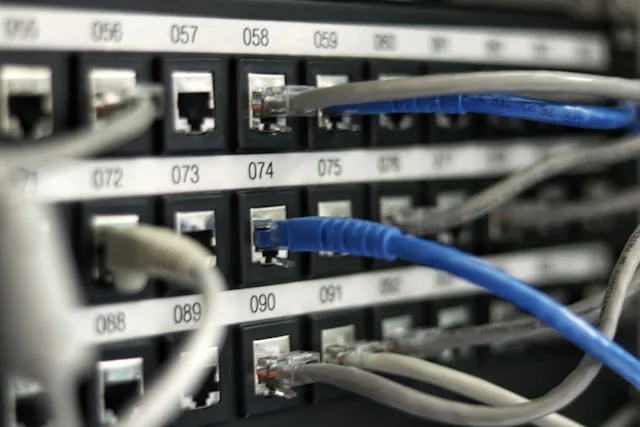
Cable routes, termination, labels, patch panels, racks, grounding, and power management follow installation standards.
Survey, access-point placement, channels, transmit power, and controllers are designed for coverage and user movement.
VLANs, firewalls, access policies, guest networks, and device separation limit the impact of faults or misuse.
Links, throughput, coverage, configuration, and labels are tested and documented so troubleshooting does not depend on memory.
The same team carries project context from planning until the system is ready to operate.
We map users, workflows, integrations, risks, and the business outcomes the system must support.
System structure, interfaces, data, security, and implementation plans are agreed before delivery begins.
Delivery proceeds in stages with functional, performance, compatibility, and security testing.
The system is deployed, users are guided, and performance is monitored for continuous improvement.
Yes. We audit bottlenecks, device age, cabling, configuration, and new requirements to identify what can remain.
It depends on area, building materials, user density, applications, interference, and target signal levels.
Usually, yes. Segmentation improves security, performance, access control, and troubleshooting between device groups.
Our team can help assess equipment options, integration requirements, and the right implementation scope.